
NATUROPATHIC DOCTOR IN ONTARIO
Risk of Menopausal Hormone Therapy
Updates to Risk of Menopausal Hormone Therapy
"Black Box" Warning on Hormone Therapy — What Does That Actually Mean For You?
If you’ve spent any time researching menopausal hormone therapy (MHT, previously called HRT), you’ve probably come across a serious-looking warning label describing risks of cancer, stroke, and dementia. That label has shaped how hormone therapy has been talked about — and how often it’s been prescribed — for over two decades.
In late 2025, the FDA announced it was removing that warning from estrogen-containing hormone therapy products. Patients often ask us what this means, whether it means hormone therapy is now “risk-free,” and what they should actually be weighing when they decide whether it’s right for them. This article walks through where the warning came from, what changed, and — most importantly — what we still know about the real short- and long-term risks and benefits, so you can have a genuinely informed conversation with your naturopathic doctor.
Where the Warning Came From
The boxed warning was added in 2003, shortly after the Women’s Health Initiative (WHI) — a large U.S. government-funded study — published early results suggesting that hormone therapy increased the risk of breast cancer, heart disease, stroke, and blood clots. Those findings led to a dramatic, rapid drop in hormone therapy use worldwide, and to warning language that applied broadly to essentially all estrogen-containing products, regardless of a woman’s age, the dose, the route of administration, or how soon after menopause she started treatment.
In the years since, researchers have gone back and re-analyzed the WHI data — and the picture has become considerably more nuanced. Several things stand out:
- The original WHI population was older than the women who typically start hormone therapy today. The average participant was in her early 60s, many years past menopause, and a substantial number already had cardiovascular risk factors. Risk looks very different in a 50-year-old starting therapy at the onset of menopause than in a 70-year-old starting it a decade or more later.
- The formulation studied — oral conjugated equine estrogen with a synthetic progestin (medroxyprogesterone acetate) — is not what is commonly prescribed today. Transdermal estrogen and micronized progesterone appear to carry a different risk profile than the oral, synthetic combination used in the original trials.
- This led to what’s often called the “timing hypothesis” or “window of opportunity”: starting hormone therapy before age 60, or within about 10 years of menopause, appears to have a more favorable balance of benefits and risks than starting it later in life.
Learn more about the history of hormone therapy use in North America.
What Actually Changed in 2025–2026
On November 10, 2025, the FDA and the Department of Health and Human Services announced they would remove the boxed warning language related to cardiovascular disease, breast cancer, and probable dementia from estrogen-containing hormone therapy products. This followed a formal review process, including an expert advisory panel that met in mid-2025, and public comment. Some panel members felt the existing warning overstated risk relative to current evidence, particularly for younger, recently menopausal women. The labeling changes were finalized in early 2026, with new labels expected to include more age- and timing-specific guidance.
It’s worth noting that not everyone agrees the warning should be removed in its entirety. Some women’s health researchers and advocacy groups have publicly welcomed the shift toward evidence reflecting modern formulations and dosing, while also cautioning that removing the warning shouldn’t be read as “no risk” — individualized counseling is still essential, and older, higher-risk formulations and populations still carry meaningfully different risk profiles than what’s typically prescribed now.
One warning was not removed: the label for estrogen-alone products still carries a warning about the risk of endometrial (uterine lining) cancer in women who have a uterus and take estrogen without a progestogen. This is exactly why, if you have a uterus, your treatment plan includes progesterone alongside estrogen — it protects the uterine lining.
So What Does This Mean for How We Practice?
Practically speaking: not much changes in how your ND assesses your candidacy for hormone therapy. We were already individualizing decisions based on your age, time since menopause, personal and family health history, and specific risk factors — using tools like breast cancer, cardiovascular, and fracture risk calculators — rather than relying on a blanket label. What the label change reflects is that the underlying science has caught up to that individualized approach, and it may mean more women who are good candidates feel less unnecessarily alarmed about starting therapy.
Short-Term Side Effects
Most side effects from starting hormone therapy are mild and tend to improve within the first one to three months as your body adjusts. The most common are sometimes nicknamed the “four B’s”:
- Bleeding or spotting — common in the first 3–6 months, especially on combined cyclic therapy
- Breast tenderness
- Bloating and fluid retention
- The “Blues” — mood changes, which are usually transient
Other short-term effects can include headaches, nausea, dizziness, leg cramps, acne, and fatigue. These are usually manageable by adjusting the dose, the specific formulation, or the route of delivery (patch, gel, or oral) — which is exactly why we schedule a follow-up visit a few months after starting therapy rather than just sending you off with a prescription indefinitely.
Long-Term Risks — What We Know Today
Breast cancer. This is usually the biggest concern patients raise, and it deserves a careful answer. Combined estrogen-progestogen therapy is associated with a small increase in breast cancer risk that becomes more apparent with longer duration of use (generally after about 5 years), and appears to decline again after stopping. It’s important to note that this risk is calculated based on a woman taking a synthetic progestin (Medroxyprogesterone acetate – MPA), which is not the form of progesterone that naturopathic doctors prescribe. We prescribed bioidentical micronized progesterone, a substance that your body naturally makes on its own, and which declines in perimenopause, and disappears in menopause. Estrogen-only therapy (used in women without a uterus – post-hysterectomy) has not shown the same pattern in the WHI data, and some analyses suggest it may be associated with little to no increase, or even a slight reduction, in breast cancer risk. It’s important to understand this in terms of absolute, not just relative, risk: even where a relative increase is reported, the added number of breast cancer cases per year for an individual woman is small. Your personal risk also depends heavily on your baseline risk profile — which is exactly why we run a breast cancer risk assessment before starting therapy, and why family history or genetic risk factors change the conversation. There are other modifiable factors that impact your risk of developing breast cancer, such as history of breastfeeding (very good!), alcohol consumption (bad), smoking tobacco (bad), being overweight (very bad), exercising regularly (great!).
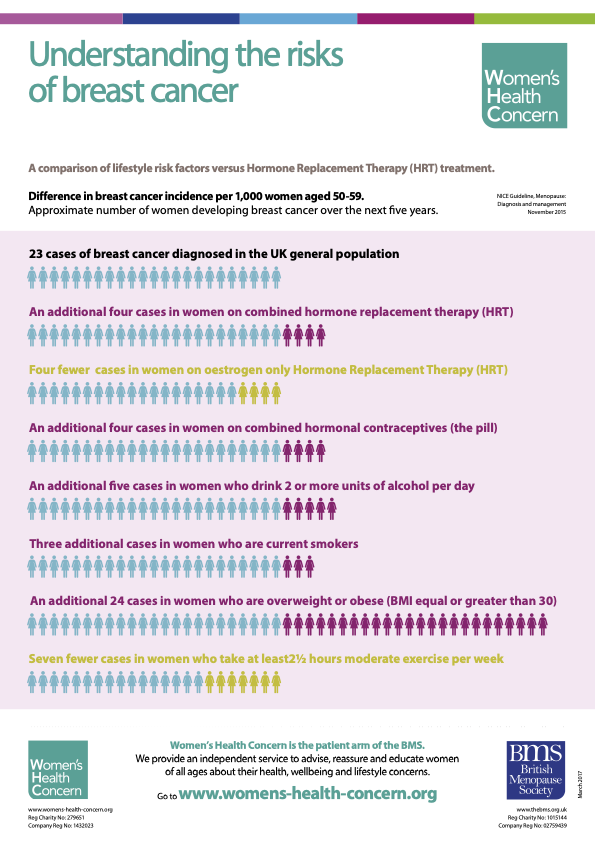
It’s worth mentioning breastfeeding here too, since it’s one of the more significant modifiable factors in lifetime breast cancer risk, and it’s a piece of history worth having in mind alongside everything else we’re weighing. A landmark analysis pooling data from 47 studies across 30 countries — over 50,000 women with breast cancer and nearly 100,000 without — found that the relative risk of breast cancer dropped by about 4.3% for every 12 months of breastfeeding, on top of a separate reduction associated with each birth. The effect is cumulative: it adds up across however many children a woman breastfeeds and for however long, and the protective effect has been observed regardless of a woman’s age, ethnicity, or how many children she’s had. Later research has refined this picture somewhat — the protective effect appears strongest against hormone-receptor-negative and triple-negative breast cancer, with less consistent evidence for hormone-receptor-positive disease, which is the most common subtype. Breastfeeding history isn’t something we can change after the fact, but it’s a genuinely relevant piece of your personal risk picture, alongside the factors above, when we’re having this conversation together.
Blood clots (VTE) and stroke. This is one area where route of administration clearly matters. Oral estrogen carries a higher risk of venous blood clots and stroke than transdermal estrogen (patch, gel, or spray), because oral estrogen is processed through the liver first, affecting clotting factors. For women with any elevated risk of clotting — including migraine with aura, obesity, or a personal or family history of clots — transdermal delivery is generally preferred for this reason.
Cardiovascular disease. This is where the “timing hypothesis” matters most. In women who start hormone therapy before age 60 or within about 10 years of menopause, and who don’t have significant baseline cardiovascular risk, hormone therapy has not been shown to increase — and in some analyses appears to reduce — cardiovascular risk. Starting later, or in women with existing cardiovascular disease, shifts that balance unfavorably, which is why we screen cardiovascular risk before prescribing and reassess it at every renewal.
Gallbladder disease. Estrogen, especially oral estrogen, is associated with an increased risk of gallstones and gallbladder disease. Transdermal routes appear to carry less of this risk.
Endometrial cancer. Unopposed estrogen (without progesterone) significantly increases the risk of endometrial cancer in women with a uterus. Taking progesterone as prescribed alongside estrogen essentially eliminates this excess risk — which is why consistent progesterone use isn’t optional if you have a uterus.
Long-Term Benefits
The risk conversation only tells half the story. For appropriate candidates, hormone therapy has real, well-documented benefits:
- The most effective available treatment for hot flashes, night sweats, and vaginal/urogenital symptoms of menopause
- Protection against bone loss and reduced fracture risk
- Possible reduction in colorectal cancer incidence
- Potential cardiovascular benefit when started within the “window of opportunity”
- Meaningful improvement in sleep, mood, joint pain, and overall quality of life for many women
- Emerging (though still developing) evidence around reduced risk of cognitive decline when started early
The Bottom Line
The removal of the boxed warning doesn’t mean hormone therapy is risk-free — no medication is — but it does reflect a genuine, evidence-based shift away from a one-size-fits-all warning that didn’t account for age, timing, dose, route, or individual risk factors. The core message hasn’t changed: your personal risk-benefit picture depends on you — your age, how long it’s been since menopause, your family and personal health history, and the specific formulation and route we choose together.
That’s exactly why our process involves a full history, targeted lab work, and standardized risk screening before we prescribe anything, and why we reassess at every follow-up rather than treating a prescription as a one-time decision. If you have questions about how any of this applies to your specific situation, that’s exactly what your visit with us is for.
Learn More
- The Menopause Society (formerly NAMS) — for patients
- International Menopause Society — patient videos
- British Menopause Society — factsheets
- FDA/HHS announcement on the November 2025 labeling changes: search “FDA menopausal hormone therapy boxed warning removal” for the current release on fda.gov
This article is for general education and isn’t a substitute for an individualized conversation with your ND about your own health history and risk factors.
Dr. Sarah Goulding, ND
Dr. Sarah Goulding is a licensed naturopathic doctor in Ontario and has a BSc in neuroscience and biology from Dalhousie University (2004), and did her 4-year naturopathic training at the Canadian College of Naturopathic Medicine (2010). She’s since accumulated over a decade of clinical experience, and refined her practice to focus on women’s health and digestion. She is licensed and registered as a Naturopathic Doctor in Ontario by The College of Naturopaths of Ontario (CONO) and is a member of the Canadian Association of Naturopathic Doctors (CAND) and the Ontario Association of Naturopathic Doctors (OAND).
Dr. Sarah Goulding blends science and compassion, and acts as a personal health researcher to help you navigate your health. Tools that she uses include nutrition, supplements and botanicals, bioidentical hormones, and lifestyle modifications. The closer you get to the root cause, the gentler the therapies needed to resolve the issue.
Dr. Janna Fung, ND
Dr. Janna Fung is a licensed naturopathic doctor with a special interest in dermatology and women’s health. She has a passion for evidence based preventative medicine and strives to empower patients with the knowledge to achieve their optimal health. She understands collaborations is the only way to develop realistic sustainable health/wellness results and strives to develop individualized health goals with patients.
